The Word Everyone Uses, Few Understand
The Word Everyone Uses, Few Understand
In the last lesson, you saw how small samples lie. You watched a true 1.5 MOA rifle produce groups ranging from 0.2 MOA to 3.6 MOA just by random chance across different sample sizes. You saw how a load with a real 15 fps spread can show single-digit numbers in a 5-shot string.
Now comes the natural question: “Okay, so what AM I actually measuring? What does ‘consistency’ even mean?”
This matters because every reloading forum, every YouTube video, every magazine article throws around “consistency” like we all agree on what it means. We don’t. And that confusion is costing you money and sanity.
Here’s what usually happens: Someone shoots three tight groups and declares their load “consistent.” Another shooter gets 8 fps spread on ten rounds and calls that “consistent.” A third person measures case neck interference to 0.001” and claims that’s the path to “consistency.”
They’re all talking about different things.
Let’s fix that. By the end of this lesson, you’ll have crystal-clear definitions that make sense, and you’ll understand the single most important concept in statistical testing: the difference between what you tested and what you think you know.
Consistency Means Predictable, Not Perfect
Here’s the truth that nobody wants to hear: Consistency doesn’t mean all your shots go in the same hole. It doesn’t mean zero spread. It doesn’t mean perfection.
Consistency means predictable.
Think about a metronome. Tick… tick… tick… Perfectly consistent, right? But it’s not “perfect” in some absolute sense. It’s just reliably predictable. You know what it’s going to do next because it does the same thing over and over.
Now think about a drummer keeping time. Even a great drummer isn’t a metronome, there’s some variation. Over the course of a song, some beats come a hair early, some a hair late. But a consistent drummer has a predictable average tempo with small, random variation around it. You can dance to that. You can play music with that.
An inconsistent drummer? The tempo wanders. Big jumps. You can’t predict the next beat. That’s chaos, not music.
Your ammunition is the drummer. We’re trying to figure out if it keeps steady time or if it’s all over the place.
The Three Flavors of Consistency We Care About
When reloaders say “consistency,” they usually mean one of three different things:
1. Velocity Consistency - “How spread out are my shot speeds?”
- Measured as spread in feet per second (fps)
- Matters most for: Trajectory prediction at distance
- Why it matters: Velocity differences cause vertical spread downrange
2. Precision Consistency - “How spread out are my shots on target?”
- Measured as group size (MOA or inches)
- Matters most for: Hitting small targets
- Why it matters: This is literally your ability to land shots where you aim
3. Repeatability - “Does this happen the same way next time?”
- Measured by testing the same thing multiple times
- Matters most for: Trusting your results
- Why it matters: One lucky session means nothing
Most confusion happens because people measure #1 (velocity spread), assume it means #2 (precision), and never check #3 (repeatability).
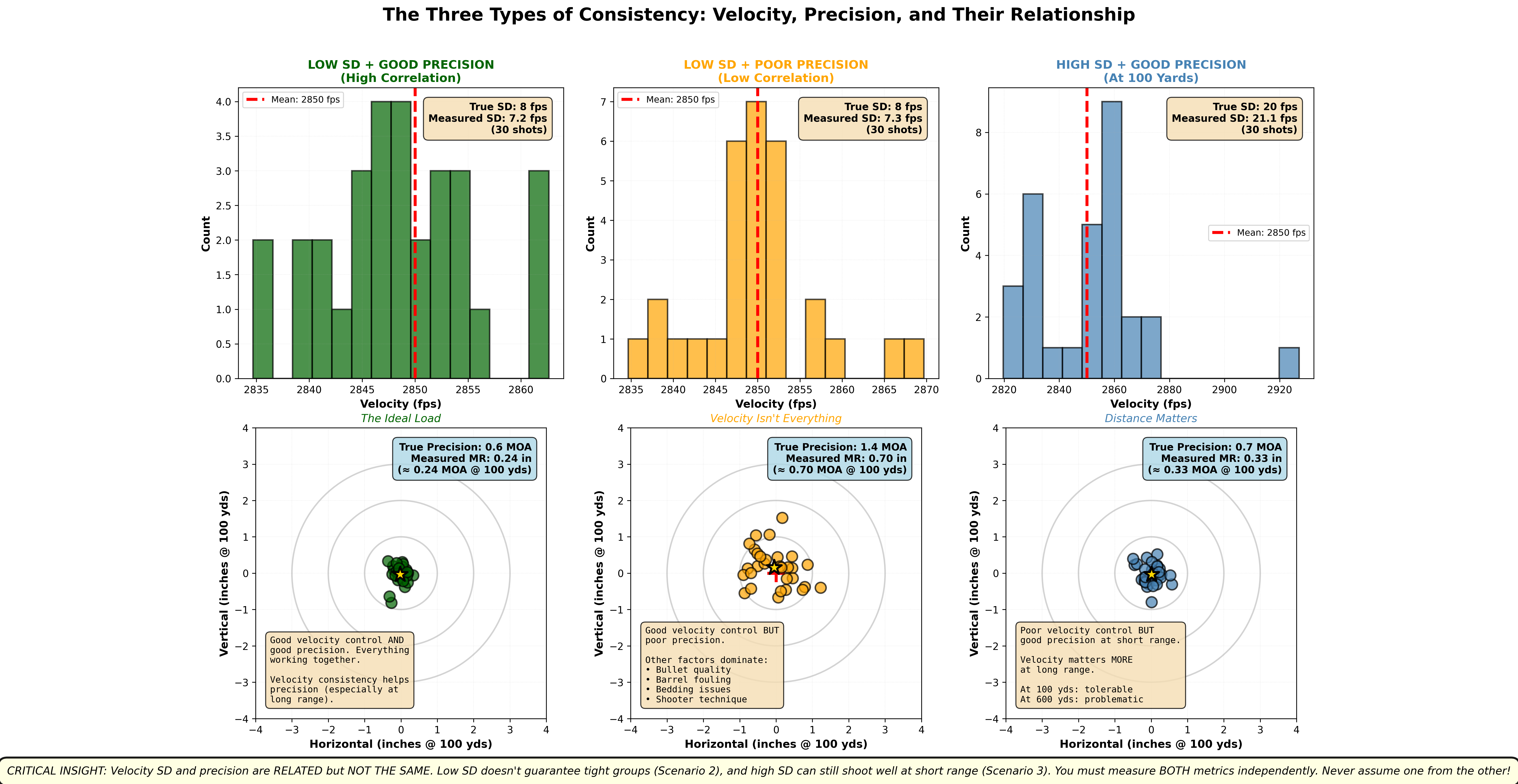
Figure 2: Three scenarios demonstrate that velocity consistency (SD) and precision (group tightness) are related but NOT the same. Left: Low SD with good precision shows the ideal correlation. Center: Low SD with poor precision proves that velocity control alone doesn’t guarantee tight groups—other factors like bullet quality or bedding dominate. Right: High SD with good precision at 100 yards shows that velocity variation matters less at short range but becomes problematic at distance. The critical takeaway: you must measure BOTH velocity SD and on-target precision independently. Never assume one from the other!
Key Insight
Velocity consistency and precision consistency are related but NOT the same thing. You need to measure both, and you can’t assume one from the other.
The Ocean and the Cup: Population vs. Sample
This is the most important concept in this entire curriculum. Miss this, and nothing else makes sense. Get this, and you’ll spot bad claims from a mile away.
The Ocean of Possibility
Imagine you’ve just developed a new load recipe:
- 42.0 grains of your chosen powder
- Your preferred primer
- Your bullets seated at a specific depth
- Your brass, carefully prepped
Now imagine you load 10,000 rounds with this exact recipe. Not 10 or 20 or 50—ten thousand rounds, all theoretically identical.
If you could shoot all 10,000 rounds and measure every velocity, plot every group, you’d see the true performance of this load recipe. That complete picture—all possible rounds you could ever make with this recipe—is called the population.
The population has a true average velocity. It has a true spread (the real amount of variation). It has true precision (what it really does on target). These are REAL numbers that exist, even though you’ll never actually measure them perfectly.
Here’s the problem: You’ll never shoot 10,000 rounds to test one load. You’ll shoot 10, maybe 20 if you’re patient, possibly 30 if you’re following best practices.
Those 10 or 20 or 30 rounds are called a sample.
The Cup of Water
Here’s the analogy that makes this click:
The population is the ocean. It’s vast, complete, unknowable in its entirety. It has a true temperature, true salinity, true depth. The real properties.
Your sample is a cup of water dipped from that ocean.
The cup shows you something about the ocean:
- The temperature of the cup is probably close to the ocean’s temperature
- The salinity is probably similar
- You can learn useful things from the cup
But the cup doesn’t show you:
- The waves
- The currents
- The full depth
- The temperature variations at different locations
- The complete picture
In reloading terms:
You shoot 10 rounds (the cup). You get an average velocity of 2,850 fps and a spread of 12 fps.
What you know: Those 10 rounds had that average and spread.
What you think you know: Your load recipe (the ocean) has an average of 2,850 fps and a spread of 12 fps.
What’s actually true: The load recipe’s true average is probably close to 2,850 fps (averages are reliable), but the true spread could easily be 8 fps or 18 fps (spread is unreliable with small samples).
The cup gives you a glimpse, not the full picture.
Why This Matters More Than Anything Else
Every time you see a claim online:
- “My load shoots 2,800 fps with 6 fps SD”
- “This recipe gives me 0.5 MOA groups”
- “I found the perfect node”
Ask yourself: “Is that the ocean, or just their cup?”
Almost always, it’s the cup. They dipped once, got lucky, and declared they know the ocean.
You’ve already seen this in Lesson 01. Remember those simulations showing how a true 15 fps load can give you 8 fps in a 10-shot sample just by luck? That’s the cup lying about the ocean.
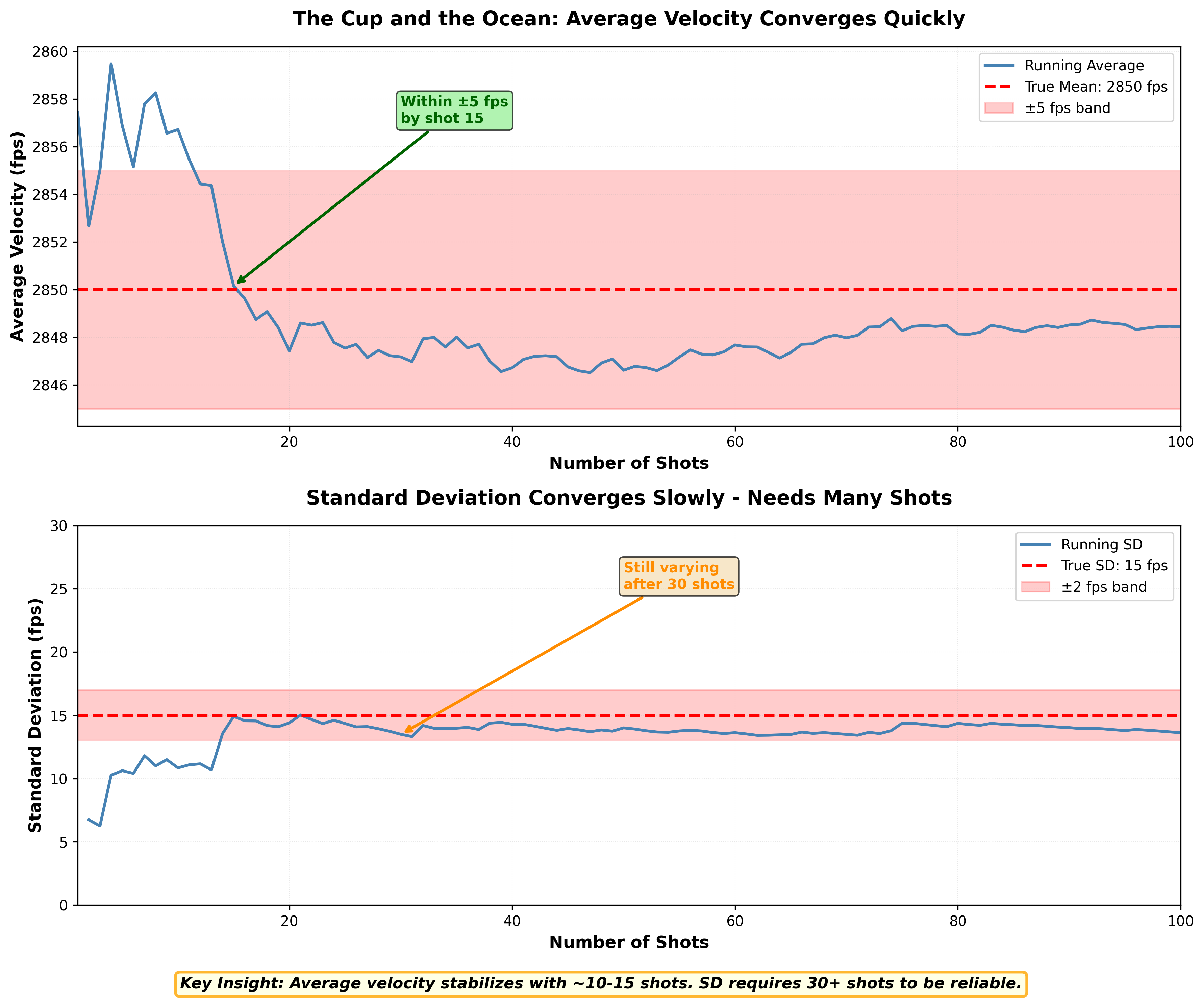
Figure 1: Visual demonstration of the cup and ocean analogy - showing how random samples (cups) from a true population (ocean with mean 2,850 fps and SD 15 fps) vary in their measurements. Small samples produce highly variable results that bounce around the true values, while larger samples converge closer to the truth. This fundamental concept explains why you never measure the population directly. You always work with samples, and small samples are unreliable cups that mislead you about the ocean.
Critical Takeaway
You never measure the population (the ocean) directly. You always work with samples (cups of water). Small samples are unreliable cups, as they mislead you about the ocean. Larger samples are more trustworthy, but even they aren’t perfect. This is why sample size matters so much.
Consistency Is Not a Single Number
Here’s another trap people fall into: reducing consistency to one number.
“What’s your SD?” “What’s your group size?” “What’s your extreme spread?”
Consistency is a pattern of behavior over many rounds, not a single measurement from one session.
Let me show you what I mean with a real scenario:
Scenario A: The Consistent Load
You test a load across three range sessions (30 shots each session):
- Session 1: Average velocity 2,850 fps, spread of 14 fps, average group size 0.9 MOA
- Session 2: Average velocity 2,848 fps, spread of 13 fps, average group size 0.8 MOA
- Session 3: Average velocity 2,851 fps, spread of 15 fps, average group size 0.9 MOA
This is consistent. The numbers are similar across sessions. Predictable. You can trust this load to behave this way in the future.
Scenario B: The Inconsistent Load
You test another load the same way:
- Session 1: Average velocity 2,850 fps, spread of 8 fps, average group size 0.6 MOA (Amazing!)
- Session 2: Average velocity 2,863 fps, spread of 22 fps, average group size 1.3 MOA (Terrible!)
- Session 3: Average velocity 2,845 fps, spread of 11 fps, average group size 0.9 MOA (Okay)
This is inconsistent. The numbers jump around wildly. You have no idea what this load will do next time. That perfect Session 1 was luck.
Which load would you rather hunt with? The predictable one that does 0.9 MOA every time, or the wild card that might do 0.6 MOA or might do 1.3 MOA?
Consistency is reliability over time, not a single impressive number from one lucky day.
The Hard Truth About Single Sessions
If you’ve tested a load only once—even with 30 shots—you don’t know if it’s consistent yet. You know what it did that one time. That’s it.
Real consistency requires:
- Testing the same load multiple times (3+ sessions if possible)
- Seeing similar results each time
- Only then trusting the pattern
I know, I know. That’s a lot of shooting. But would you rather:
- Waste 30 rounds testing once and guessing, or
- Invest 60-90 rounds testing properly and actually knowing?
The second option saves you money long term because you stop chasing ghosts.
What Actually Drives Consistency? The Component Hierarchy
Now that we’ve defined what consistency actually means, let’s talk briefly about what creates it. This isn’t a deep dive (we’ll save that for later lessons), but you need to understand the basics.
Your ammunition’s consistency comes from a combination of factors. Not all factors matter equally. Here’s the hierarchy from most important to least:
1. Bullet Quality (~40% of variation)
The projectile itself is the biggest driver of consistency. A bullet that’s:
- Concentric (balanced around its axis)
- Uniform (same weight, same jacket thickness)
- Consistent lot-to-lot
…will produce better results than perfect powder charges behind a mediocre bullet.
Why: An unbalanced bullet starts yawing (wobbling) the moment it leaves the barrel. No amount of careful powder measuring fixes that.
What this means for you: Buy quality bullets from known manufacturers. Don’t cheap out here. Sorting by weight or measuring ogive length on budget bullets is lipstick on a pig.
2. Powder Metering (~30% of variation)
Consistent powder charges matter, but not as much as people think. Within normal operating pressures, charge weight variation has VERY LITTLE effect on precision for a given propellant. However, there is a direct relationship to charge weight and velocity. The difference between 42.0 grains and 42.1 grains is often smaller than bullet-to-bullet variation. If you have very tight velocity spread needs, you will be able to calculate charge weight variation effect on velocity by the end of this course.
Why: Small variations in powder charge do create velocity variation, but other metrics have a more profound effect on group size.
What this means for you: A good powder measure or scale that’s consistent to ±0.1 grain is plenty for most purposes. Trickling every charge to the exact kernel is usually overkill unless you’re shooting long range. If you need this level of velocity consistency, then improving velocity spread will improve your velocity SD.
3. Brass Quality and Prep (~20% of variation)
Using the same brand and lot of brass matters. Weight sorting, volume measuring, and neck turning matter much less than people claim, especially with premium brass. This is NOT advice to mix lots, brands, or use brass of otherwise unknown origin. The lipstick on a pig analogy very much applies to “fixing” poor quality brass.
Why: Modern premium brass (Alpha, Lapua, possibly others) is already remarkably consistent. Weight variations come mostly from differences in case head thickness, which doesn’t affect internal volume much.
What this means for you: Buy good brass, use the same lot, and don’t obsess over sorting it. The time spent weight-sorting would be better spent practicing shooting fundamentals. If you want to sort brass, measure fired water volume to a statistically significant degree.
4. Primers (~10% of variation)
Primer choice matters, but primer-to-primer variation within the same lot is minimal with quality products. The internet is full of claims about switching primers and seeing dramatic SD drops. Most of those are small sample artifacts (remember the cup and the ocean?).
Why: Primers do affect velocity (different brisance, different energy), but modern primers are remarkably consistent within a lot. I do not say this to imply primers are directly interchangeable. Different “strength” of primers or brisance can and do cause average velocity changes. If your system (rifle, ammo, shooter) is capable, you’ll learn how to properly test the differences between primers later.
What this means for you: Find a primer that works in your rifle and stick with it. Don’t chase “better” primers based on someone’s 10-shot test.
➡️ Launch Component Contribution Analysis (Opens in New Tab)
Interactive sliders featuring:
- Four component quality sliders (Bullet, Powder, Brass, Primer)
- Real-world weighted contributions (40%, 30%, 20%, 10%)
- Live calculation of total system consistency
- Visual bar chart showing actual impact of each component
- Smart recommendations showing biggest improvement opportunities
Money-Saving Insight: Where to Spend Your Effort
Based on this hierarchy, here’s the smart approach:
High-Priority (Do This):
- Buy quality bullets from manufacturer’s with a reputation of consistent quality
- Use a consistent powder measuring method (±0.1 grain)
- Buy premium brass and use same lot
- Stick with proven primers until you properly test alternatives
Low-Priority (Don’t Obsess):
- Weight-sorting brass - If you are concerned, sort by internal volume
- Measuring case neck thickness - Good to know for other reasons, but not for our current purposes
- Turning case necks (unless there are obvious issues or addressing a specific problem)
- Primer pocket uniforming - Sometimes “uniforming” does more harm than good. Start with brass suitable for your needs.
- Trickling to exact kernel count - If you “need” this step, you’ll know by the time we are finished.
The internet is full of people doing low-priority tasks and attributing success to them. Remember: small samples create illusions. They sorted brass, shot one good group, and declared victory. Correlation isn’t causation.
Focus your limited time and money on what actually matters.
The Foundation is Set
You now understand:
- What consistency actually means: Predictable performance over many rounds, not one lucky session
- The three flavors: Velocity consistency, precision consistency, and repeatability
- Population vs. Sample: The ocean and the cup—the single most important concept in testing
- Consistency over time: Why single sessions can’t prove anything
- Component hierarchy: What actually drives consistent results
This foundation changes everything. You now have a framework for evaluating any claim you see online:
- Is that the ocean or just a cup?
- Did they test once or multiple times?
- How many shots are they basing that on?
- Are they confusing velocity consistency with precision?
In the next lesson, we’ll tackle the question everyone asks: “Okay, so how many shots DO I need?” You already know the answer is more than 3, but now you’ll understand exactly why and learn to calculate it yourself.
Key Takeaways
- Consistency means predictable, not perfect
- Velocity consistency and precision consistency are different things
- You measure samples (cups) but want to understand the population (ocean)
- Small samples (small cups) are unreliable indicators of true performance
- Consistency requires multiple testing sessions, not just one lucky day
- Component quality drives results: bullets matter most, brass weight sorting matters least
- Focus your effort on high-impact factors, not internet mythology
Coming Up Next
In Lesson 03, we’ll answer the practical question: How many shots do you actually need to test a load reliably? You’ll learn:
- Why 30 shots is the magic minimum for spread measurements
- Why 10 shots can work for velocity averages but not for consistency
- How to calculate sample sizes for your specific testing goals
- The cost-benefit analysis of “good enough” vs. “really sure”
The foundation you just built will make the next lesson click instantly. You understand the ocean and the cup. Now you’ll learn how big your cup needs to be.
| Previous: 01 The Biggest Lie in Reloading Testing | Next: 03 How Many Shots Do You Really Need |